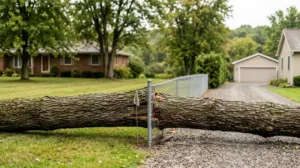
Homeowners insurance covers emergency tree removal only if the fallen tree or branch damages a covered structure, such as your house, garage, or fence. If a winter storm downs a tree cleanly across your lawn or driveway without damaging an insured building, insurance will not pay for tree removal or debris disposal.
The Core Rule: Structure Hit vs. Ground Fall
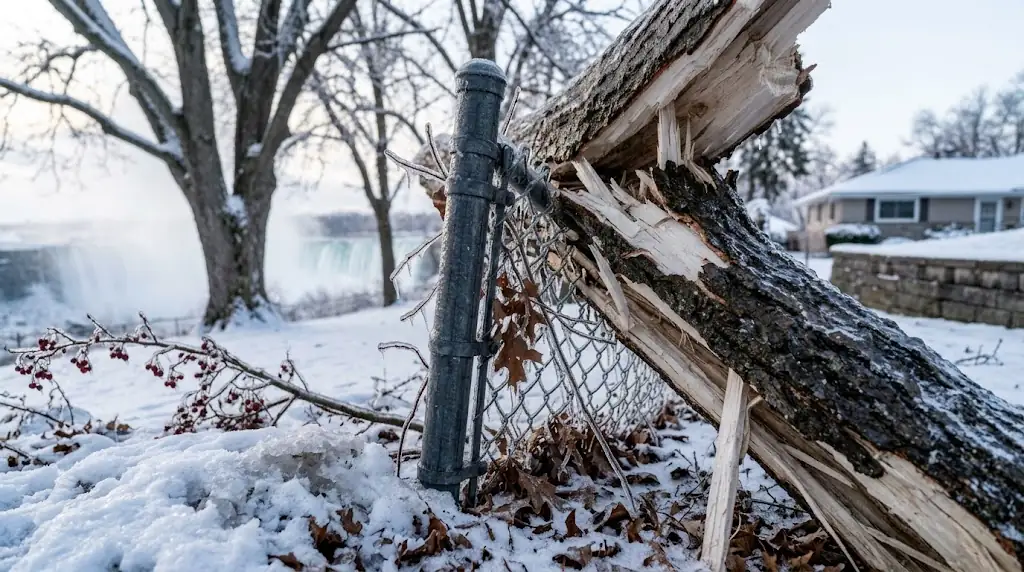
Western New York winter storms—driven by lake-effect snow bands off Lake Erie and intense freezing rain off Lake Ontario—regularly coat hardwood canopies in tons of ice. When branches or trunks snap, insurance adjusters evaluate the claim based strictly on what the tree landed on.
| Damage Scenario | Covered by Homeowners Insurance? | Typical Policy Payout Terms |
| Tree crashes onto roof, siding, or chimney | Yes | Policy pays for dwelling repairs plus removal of the tree off the structure (typically capped at $500–$1,000 for removal). |
| Tree crushes detached garage, shed, or fence | Yes | Covered under “Other Structures” (Coverage B), including tree extraction up to sub-limits. |
| Tree blocks driveway or handicap ramp | Sometimes | Standard HO-3 policies often cover removal up to $500 if the tree blocks vehicular access or accessibility ramps. |
| Tree falls completely on open lawn or garden | No | Zero insurance payout. The homeowner covers 100% of removal and chipping costs out of pocket. |
| Tree falls on personal vehicle in driveway | No (under Homeowners) | Homeowners insurance excludes the car; comprehensive coverage on your auto insurance policy handles vehicle damage. |
Understanding Policy Sub-Limits for Debris Removal
A common misunderstanding among Niagara County homeowners is assuming that insurance pays the complete bill for massive tree dismantling.
Insurance carriers distinguish between stabilization (getting the tree off the house to stop active water infiltration) and debris disposal (chipping, hauling, and stump grinding).
- Extraction vs. Hauling: Carriers cover the cost to safely lift the trunk off the roof rafters and tarp the roof under the general dwelling limit (Coverage A).
- Debris Removal Caps: The cost to haul the remaining timber, chip branches, and clean up the yard is almost universally capped under an “Additional Coverage: Debris Removal” clause. In New York, this limit is typically $500 to $1,000 per tree, with a total event cap of $1,000 to $2,000 regardless of how many trees fell.
- The Deductible Factor: If an emergency crane extraction and debris removal costs $1,800, and your homeowner deductible is $1,000 or $1,500, filing a claim may yield negligible reimbursement while adding a loss record to your CLUE report.
4 Exclusions That Lead to Denied Claims
Insurance carriers do not cover every winter storm failure. Adjusters routinely inspect trunk cross-sections and root plates for disqualifying pre-existing conditions:
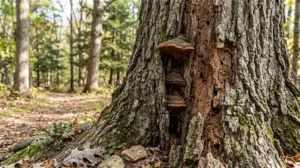
- Prior Rot and Neglect: If an arborist or insurance adjuster discovers that the fallen tree was long dead, hollowed by carpenter ants, or completely decayed before the winter storm, the carrier can deny the entire structural claim citing homeowner neglect.
- Preventable Root Instability: Trees with severed root systems from recent driveway paving or utility trenching that fail during high winds may be categorized as improper maintenance rather than storm casualty.
- Earth Movement Exclusions: If saturated clay soil along the Niagara Escarpment gives way, causing a slope failure that pulls trees down with it, standard homeowners policies exclude damage under the earth movement/landslide clause.
- Flood and Ice Jam Surges: Trees washed out by riverbank flooding along the lower Niagara River or Tonawanda Creek are subject to National Flood Insurance Program (NFIP) guidelines, not standard homeowner policies.
Step-by-Step Insurance Protocol After a Niagara Storm
When gale-force lake-effect winds or heavy snow down a tree onto your property, execute these steps in order:
Claim Sequence: 1. Safety Check → 2. Damage Mitigation → 3. Photo Evidence → 4. File Claim → 5. Contractor Removal
- Verify Life Safety First: Ensure downed branches have not brought down primary electric service drops. If wires are sparking or touching branches, stay at least 35 feet away and contact National Grid or NYSEG immediately.
- Mitigate Further Damage: New York insurance policies require policyholders to protect the property from secondary damage. Tarping punctured roofs or boarding cracked windows is legally required to prevent water leaks from voiding interior coverage.
- Document Exhaustively Before Cutting: Take wide-angle photos showing the tree resting on the structure, close-ups of the roof puncture, and shots of the stump to prove the tree was green and structurally sound before the ice load snapped it.
- Open an Emergency Claim: Report the date, time, and weather conditions (such as a documented National Weather Service winter storm warning for Niagara County). Obtain a formal claim number before heavy machinery arrives.
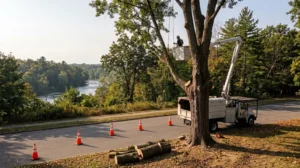
- Hire an Insured Tree Contractor: Provide the insurance company with an itemized invoice that explicitly separates structural extraction costs from wood chipping and hauling charges.
Municipal Tree Damage: When a City Tree Hits Your House
In dense neighborhoods across the City of Niagara Falls, North Tonawanda, and Lockport, thousands of mature silver maples and oaks occupy municipal right-of-way strips between the sidewalk and curb.
- Filing a Claim Against the City: If a city-owned street tree crushes your roof or garage during a winter storm, the city is not automatically liable under New York municipal law.
- The 90-Day Rule: To recover damages from a municipality, you must prove the city had written notice of the dead tree’s defect prior to the storm and failed to act. If applicable, you must serve a formal Notice of Claim within 90 days under New York General Municipal Law § 50-e.
- The Fastest Route: File through your private homeowners carrier first. Your insurance company will pay for your repairs (minus your deductible) and handle municipal subrogation recovery on your behalf.
Clear Dangerous Storm Timber Without Delay
Heavy lake-effect ice loads and sudden squalls can turn mature canopy trees into immediate hazards for your roof and family. If an emergency storm event has compromised a tree over your home or driveway, reach out to the certified, fully equipped crews at Niagara Falls Tree Removal directly through our contact page for rapid hazard mitigation and itemized insurance documentation.