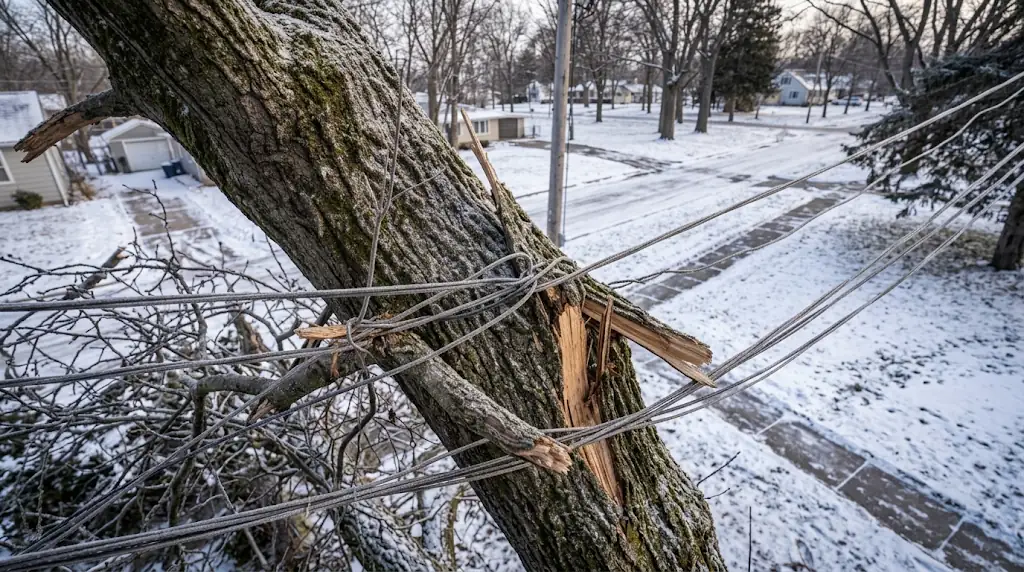
To safely handle a leaning tree tangled in power lines in Niagara County, stay at least 30 feet away and report the hazard immediately to National Grid, NYSEG, or 911. You must never touch the tree or attempt to cut it down yourself, as wood conducts high-voltage electricity when wet or under pressure.
4 Immediate Action Steps for Tangled Trees
When a storm, soil erosion, or root failure pushes a tree into overhead lines, follow this immediate emergency sequence:
- Evacuate the Drop Zone: Keep all people, pets, and vehicles at least 30 feet away from the tree, the utility pole, and any sagging wires.
- Treat All Lines as Live: Assume every wire is energized with lethal voltage. A non-sparking, silent wire can remain fully charged.
- Contact the Electric Utility Provider: Call the utility responsible for your specific Niagara County municipality before contacting any private tree service:
- National Grid (Primary utility for Niagara Falls, North Tonawanda, Lewiston, Wheatfield): 1-800-867-5222
- NYSEG (Eastern Niagara County / Lockport area): 1-800-572-1131
- Immediate Sparking / Fire Danger: Call 911.
- Schedule a Private Contractor After Clearance: Once the utility company cuts power or clears the primary electrical contact, a licensed tree care service can safely step in to dismantle the rest of the timber.
Primary High-Voltage Lines vs. Residential Service Drops
Utility responsibilities depend entirely on whether the tree affects the main grid or the individual line connecting to your house:
| Wire Type | Location & Voltage | Who Is Responsible for Clearing the Tree? |
| Primary / Secondary Distribution Lines | Run from pole to pole along streets; high voltage (2,400V to 34,500V+). | The Utility Company (National Grid / NYSEG). Utility crews de-energize and clear branches threatening the grid. |
| Service Drop | Runs from the street pole directly to the weatherhead on your house (120V / 240V). | The Property Owner. Utilities generally do not prune for private service drops; the homeowner must hire an insured professional. |
| Communication Cables | Lowest wires on the pole (telephone, internet, cable TV). | The Telecom Provider / Homeowner. Low voltage, but cables can still carry dangerous induced current or touch live power wires above. |
What Does the Utility Company Clear?
When National Grid or NYSEG responds to a hazardous tree call, their legal obligation is strictly limited to grid safety and service restoration:
- Make-Safe Cutting: Utility line crews or their contracted line clearance arborists will only cut away the specific limbs contacting or threatening the wires.
- Debris Left on Site: Utilities do not clean up, chip, or haul away wood. Cut logs and sheared branches are left on the homeowner’s lawn.
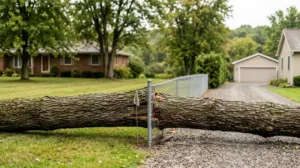
- Remaining Trunk Dismantling: If the main trunk is still rooted and leaning toward your house, the utility will not remove the entire tree. The homeowner must hire a private contractor to finish the job.
Why Standard Tree Workers Cannot Cut Near Primary Lines
Standard landscape contractors and uninsured handymen are legally prohibited from working within close proximity to primary power lines.
- OSHA Clearance Standards: Under OSHA 29 CFR 1910.269, non-qualified workers and non-insulated equipment must maintain a minimum approach distance of at least 10 feet from overhead power lines (greater for voltages exceeding 50kV).
- Ground Gradient Hazards: If an energized wire touches a tree, electrical current flows down the trunk into the ground. Walking near the base can cause electrocution through “step potential,” where voltage differentials travel between your feet.
- The “Make-Safe” Process: If your private contractor needs to fell a large tree situated near your home’s service drop, they can coordinate a temporary service disconnect with National Grid or NYSEG so the tree can be safely dismantled without live power running to the weatherhead.
Managing Storm-Tangled Trees in Niagara County
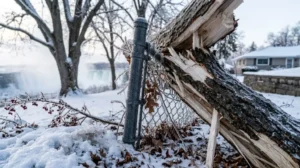
Winter ice accumulation along the Lake Ontario plain and severe wind events across the Niagara River corridor create sudden load pressures on mature canopies. If heavy timber has pulled utility lines tight across your driveway or lawn:
- Never attempt to drive over downed or low-hanging cables.
- Keep metal ladders, pole saws, and pruning shears far away from the tree canopy.
- Keep children and neighbors clear until utility line-clearance crews arrive on site.
Eliminate Hazardous Leaning Trees Safely
A leaning tree tangled near utility lines is an immediate electrical and structural emergency. Once your utility provider has inspected the line and secured the electrical threat, rely on professional equipment and trained crews to safely rig down the remaining trunk. Contact Niagara Falls Tree Removal directly on our contact page to coordinate safe dismantling and complete property cleanup.