Under New York State common law, the owner of the property where the fallen tree lands is responsible for the cleanup and damages on their own parcel. The tree owner is legally liable only if the neighbor can establish negligence by proving the tree owner had prior written notice of a dead, rotted, or hazardous tree and failed to remedy it before it fell.
The Default New York Rule: “Act of God” vs. Negligence
Western New York weather routinely produces severe lake-effect snow, freezing rain, and gale-force winds exceeding 50 mph. When weather downs an ostensibly healthy tree, New York law categorizes the collapse as an “Act of God.”
| Scenario | Legal Classification | Who Pays for Tree Removal & Repairs? |
| Healthy tree brought down by wind/ice | Act of God (Non-negligent) | The neighbor whose property was damaged (via their own homeowners insurance policy). |
| Dead/decayed tree with zero prior warnings | Unproven Negligence | The affected property owner where the wood landed; courts rarely assign retrospective fault without prior documentation. |
| Dead/diseased tree with documented notice | Proven Landowner Negligence | The tree owner (or their liability insurance carrier), provided notice was sent prior to the event. |
| Tree trunk straddling boundary line | “Boundary Line Tree” / Tenancy in Common | Both property owners share equal 50/50 legal ownership and cleanup costs. |
What Determines Legal Negligence in Niagara County?
Assigning liability to a neighbor requires overcoming a strict legal burden of proof under New York tort law. To establish negligence, three facts must exist simultaneously:
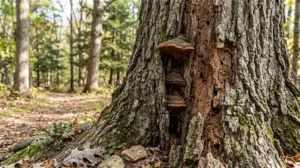
- Noticeable Hazard: The tree displayed obvious, visible symptoms of internal decay, deadwood, hollow cavities, or structural failure before the storm.
- Actual or Constructive Notice: The tree owner knew—or reasonably should have known—that the tree presented an imminent hazard to adjacent property.
- Failure to Act: The tree owner took no action to hire a qualified tree contractor or remedy the structural hazard within a reasonable timeframe.
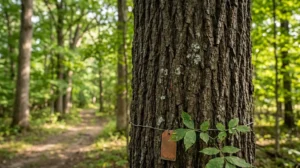
Key Takeaway: Verbal conversations between neighbors do not hold up in New York civil courts or insurance arbitration. A formal letter sent via certified mail with date-stamped photographs is the standard evidentiary benchmark for constructive notice.
How Homeowners Insurance Handles Fallen Tree Damage
Homeowners insurance carriers in New York operate on the principle of where the damage occurs, not whose root system generated the tree.
Coverage Trigger: Structural Damage Required
Standard HO-3 homeowner insurance policies require structural impact before approving removal payouts.
- Tree Strikes a Dwelling or Garage: Your insurance covers structural repairs and the cost to extract the tree from the structure (typically capped between $500 and $1,000 for the debris hauling portion).
- Tree Falls Flat on an Open Lawn: If a neighbor’s tree crashes across your grass, flower bed, or driveway without damaging an insured building, insurance policies generally exclude debris cleanup. The homeowner must pay out of pocket to clear their own yard.
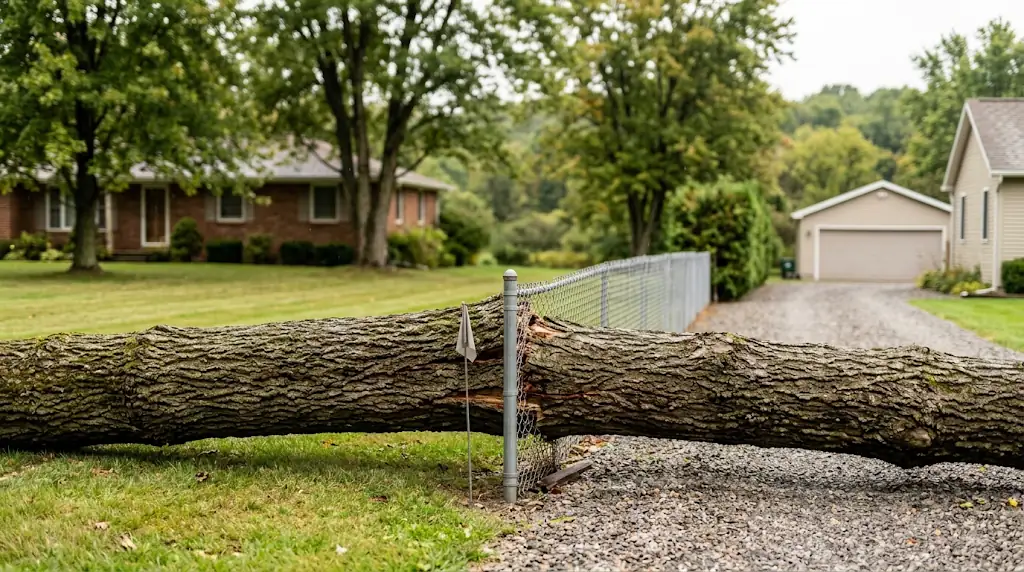
- Divided Fences: If a falling trunk crushes a shared boundary fence, adjusters evaluate boundary ownership. Often, each neighbor’s policy covers 50% of the replacement cost after their respective deductibles are applied.
Overhanging Branches: New York’s “Self-Help” Rule
You do not have to wait for a neighbor’s tree to fall to protect your property. New York State common law grants adjacent landowners the legal right of self-help.
- Vertical Property Line: You have the legal authority to prune branches, limbs, and roots that cross your boundary line up to the infinite vertical plane of your property line.
- Boundary Crossing Prohibition: You cannot enter the neighbor’s property to trim the tree without their explicit permission.
- Duty of Care (Tree Preservation): You may not prune the tree in a reckless manner that compromises its structural stability or causes it to die. If your trimming kills the neighbor’s tree, you can be held civilly liable for timber trespass under New York Real Property Actions and Proceedings Law (RPAPL) § 861, which carries penalties up to treble (triple) the stumpage value of the tree.
4 Actionable Steps When a Neighbor’s Tree Falls on Your Property
When a storm event downs timber across your property line in Niagara Falls, Lockport, Wheatfield, or Lewiston, execute this sequence:
- Document Before Touching Debris: Take high-resolution photographs and video of the fallen trunk, the root plate, the point of fracture, and all damaged structures or boundary markers.
- Contact Your Insurance Carrier Immediately: Open a claim with your own insurance agent. Provide the photos and state the exact date and time the failure occurred. Your insurer will determine whether to pursue subrogation against the neighbor’s carrier.
- Coordinate with the Neighbor: Notify the adjoining landowner of the incident. Clarify that under New York guidelines, your contractor will clear the wood on your side, while they are responsible for arranging removal on their side.
- Hire a Fully Insured Tree Service: Retain a contractor carrying commercial general liability and workers’ compensation coverage. Clearing bound, spring-loaded storm wood under tension presents extreme safety risks.
Municipal Differences: Public Trees vs. Private Properties
If a tree falls from municipal property onto private property (or vice versa), the legal framework shifts:
- City of Niagara Falls Right-of-Way: Trees situated in the curb strip between the road and the sidewalk belong to the municipality. If a city tree crushes a private fence or vehicle, claims must be filed directly through the Niagara Falls City Clerk’s office using a formal Notice of Claim within 90 days of the incident.
- County and State Highways: Roads maintained by the Niagara County Highway Department or NYSDOT have dedicated drainage easements. Downed trees blocking county right-of-ways take emergency priority for municipal road crews, but debris on private lawns remains the landowner’s task.
Resolve Property Line Tree Hazards Safely
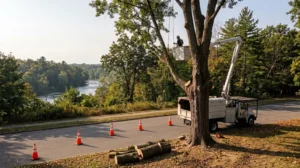
Waiting for a hazardous, diseased, or overhanging tree to fail during a Western New York storm creates unnecessary financial disputes and property damage. Whether you need a hazardous limb pruned back to your boundary line or require emergency extraction of a fallen trunk, contact Niagara Falls Tree Removal via our contact page to schedule a site evaluation.