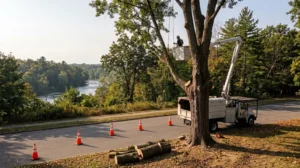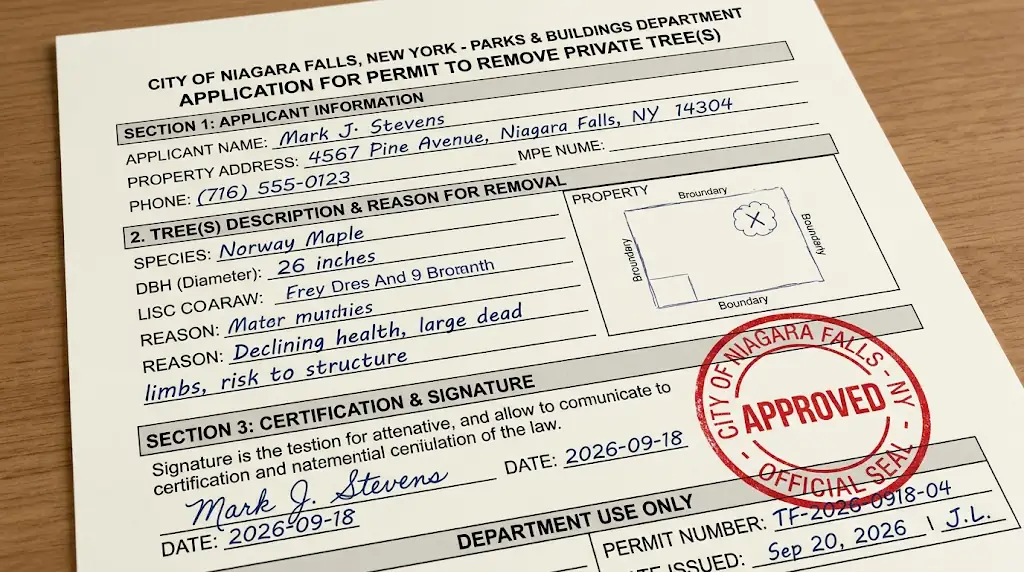
No, you do not need a permit from the Niagara County government to remove a tree located entirely within your private property lines. However, individual municipalities within the county, including the City of Niagara Falls, the City of Lockport, and various towns, have their own specific tree ordinances and may require permits or have restrictions, especially for large trees, historic trees, or trees near right-of-ways.
Niagara County vs. Local Municipal Rules
It is a critical distinction that “Niagara County” as a regional entity does not manage tree removal on private land. The authority is delegated entirely to the local cities, towns, and villages. Therefore, a blanket “no permit” rule only applies at the county level. Your local municipality’s code is what dictates the law.
Why Codes Differ Across WNY
Different municipalities have different priorities. A more urban area like the City of Niagara Falls may prioritize maintaining its urban canopy for aesthetics and heat reduction, leading to stricter rules than a more rural town in central Niagara County. Always check with your local DPW or Building Department.
Municipal Tree Permit Guide (Estimates)
This table provides a generalized guide to tree removal regulations for primary areas in Niagara County. Always confirm with your specific local office.
| Municipality | Private Tree Permit Required? | Specific Notes/Conditions | Contact Dept. (Typical) |
| City of Niagara Falls | Possibly | Ordinance focuses on ‘Significant’ trees or trees in front yards. DPW permit required for planting or removal in ROW. Private removal often needs verification. | Public Works / Building Dept. |
| City of Lockport | Usually Not | Permit required for trees in the public right-of-way. Private removal is generally unrestricted, but diameter limits may apply. | Building and Zoning |
| Town of Wheatfield | No | No town-wide permit for private property. Standard right-of-way rules apply. | Highway Dept. / Engineering |
| Town of Lewiston | Generally No | No specific private property permit. Check for overlays or historic districts. | Building Department |
| Village of Lewiston | Check | Historic districts and scenic vistas often have stricter environmental controls than the surrounding town. | Village Clerk / Zoning |
How to Determine If You Need a Permit (Step-by-Step)
To ensure you are compliant, follow this verification process:
- Identify Your Exact Municipality: Don’t just rely on your mailing address. Confirm if you live within city limits, a village, or a specific town. Your tax bill or local voting district will confirm this.
- Locate the Local Tree Ordinance: Go to your municipality’s official website and search for “Tree Ordinance,” “Vegetation Code,” or “Public Works Permits.”
- Read the Definition of “Significant Tree”: If an ordinance exists, it almost always uses a term like “Significant Tree” or “Protected Tree.” This is defined by a specific diameter at breast height (DBH), typically 8, 10, or 12 inches. Trees over this size often require permission to remove.
- Check for Restricted Areas: Is your tree near a public sidewalk, a street curb, or a designated utility easement? Is your property part of a historic preservation district or a waterfront overlay zone? These locations have special protections.
- Call the Building or Public Works Department: A two-minute phone call to your local office is the safest way to confirm. Ask: “I have a dead/dying large maple in my backyard. Do I need a permit to remove it?”
Important Regulatory Variables and Definitions
The language in local codes determines whether a permit is required. These are the most common regulatory variables in Niagara County:
- Tree Diameter (DBH): The most common trigger for a permit. You measure the tree’s trunk diameter at approximately 4.5 feet above the ground. If it exceeds the city’s limit, the tree is regulated.
- Species Protection: Rarely, certain native species (e.g., specific Oaks or historic Maples) might have elevated protections.
- Health and Hazard Status: Most codes explicitly state that dead or “Hazard Trees” are exempt from permit requirements. However, you often must prove the hazard exists (e.g., with an arborist’s report).
- Replacement Requirements: Some municipalities allow removal but mandate that you replant one or two new, approved species to maintain the canopy.
Navigating the Right-of-Way (ROW) in Niagara County
The single most common permit issue in Western New York is confusing a private tree with a “Right-of-Way Tree.” The right-of-way is the land owned by the city or town, typically extending from the street edge several feet into your front lawn.
- Who Owns the Tree? If the tree is planted between the sidewalk and the street curb (the “tree lawn”), it is a ROW tree. You are prohibited from removing or substantially pruning this tree. The responsibility for its care lies with the city or town’s Public Works Department.
- How do I Get a ROW Tree Removed? If a ROW tree is dead or hazardous, you must file a request or a 311 complaint with your municipality, which will inspect and manage the removal at public expense.
- Can I Get Permission to Remove a ROW Tree Myself? Some municipalities allow this (e.g., if you want to replace it), but it requires a specialized permit and often proves a licensed, insured contractor must be used.
Hazardous and Emergency Tree Exemptions
When Lake Ontario storms or ice events hit Niagara County, safety rules take precedence over bureaucracy.
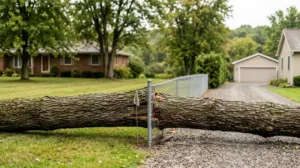
- The Pre-Existing Hazard: If a tree is actively falling, split, and leaning precariously, do not wait for a permit. Local codes universally exempt immediate life-safety hazards.
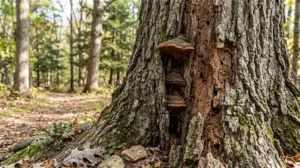
- Documentation is Key: If you must remove a regulated tree under an emergency exemption, document the hazard before the removal. Take multiple clear photos showing the split trunk, hollow base, or hazardous lean. An arborist’s letter confirming the hazard is your ultimate protection.
- Utility Lines: If the tree is interfering with power lines, call National Grid immediately. They manage line-clearance pruning. Private contractors cannot safely operate near active high-voltage lines.
Risks of Ignoring Local Tree Removal Permits
Operating without a required permit can result in severe consequences in many Niagara County municipalities. Penalties often include:
- Stop-Work Orders: If a city inspector sees unpermitted work in progress, they will immediately halt the job.
- Heavy Fines: Fines can range from $250 per occurrence to over $1,000 per tree, sometimes escalating for repeat offenses.
- Restoration Costs: You may be legally required to pay for the professional planting and multi-year care of new, large-caliber replacement trees.
Secure Your Local Permit with Confidence
Tree removal permits in Niagara County are a municipal, not a regional, matter. Whether you’re in Wheatfield, Lewiston, or the City of Niagara Falls, verifying your local ordinance is essential. If you are unsure of your regulatory requirements or need help assessing a complex tree situation, our certified and insured experts at Niagara Falls Tree Removal can help. Request a fast, compliant quote and professional guidance through the permitting process by contacting us via our contact page.